What do you need to start forex trading as a complete beginner?
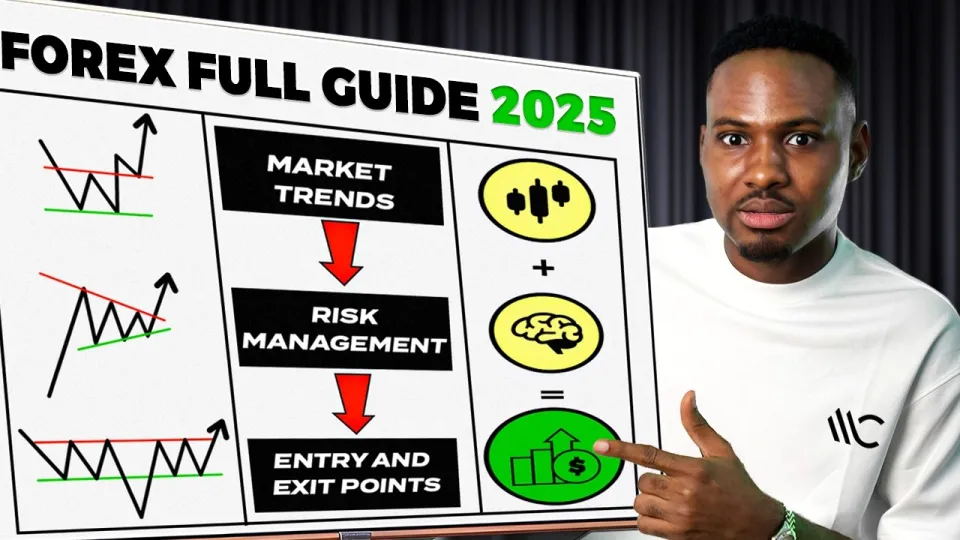
Video: How To Start Forex Trading For Beginners’ 2025 (Full Course)
Want articles like this for your own video to promote it on YouTube and Google? Order them through the Telegram bot @sat_sit_bot. The bot writes and publishes the articles itself (with your YouTube video embedded) on popular topical websites (no ads). Try it free: 50 articles on us.
· based on the channel Jeffrey Benson Forex
Forex trading for beginners means learning how currency pairs are priced, opening a demo account with a regulated broker, using a platform such as MetaTrader 5, and risking only a small fixed percentage of the account on each trade. Everything else — strategy, signals, psychology — sits on top of those four basics, and the full beginner course from Jeffrey Benson Forex builds them in that order, from what the market is to placing a first trade. The author's student plans and course access are listed at firepipsfx.com/plans.
What forex actually is and why currencies are traded in pairs
Forex is the global market for exchanging one national currency for another, and every price you see is a ratio between two currencies. A quote like EUR/USD at 1.0850 means one euro costs 1.0850 US dollars; the first currency in the pair is the base, the second is the quote. There is no single exchange building — trading happens over the counter through a network of banks, brokers and liquidity providers, which is why the same pair can be quoted with slightly different spreads depending on where you trade.
Beginners usually meet three groups of pairs:
- Majors — the most liquid pairs, all containing the US dollar (EUR/USD, GBP/USD, USD/JPY, USD/CHF, AUD/USD, USD/CAD, NZD/USD). Tightest spreads, most analysis available.
- Minors or crosses — pairs without the dollar, such as EUR/GBP or GBP/JPY. Wider spreads and sharper moves.
- Exotics — a major currency against a smaller economy's currency (USD/TRY, USD/ZAR). Attractive yields, but expensive to trade and prone to gaps.
Profit comes from the change in the exchange rate, not from owning the currency itself. If you buy EUR/USD and the rate rises, the position gains; if it falls, it loses. Leverage lets you control a larger position than your deposit, which magnifies both directions of that result — the reason risk management matters more than any indicator.
How the forex market works hour by hour
Forex trades 24 hours a day, five days a week, because the market simply moves between financial centres as they open and close. The day starts in Sydney, passes to Tokyo, then to London, and finishes with New York. The London–New York overlap is the busiest window, when the two largest sessions are open at the same time and most of the daily range tends to form.
That schedule has a practical consequence for a beginner: the same strategy performs differently at 3 a.m. and at 3 p.m. Thin liquidity in the Asian session produces narrow ranges and false breakouts on pairs like EUR/USD, while the pair's real movement often happens later. Many viewers of the course note that writing the four sessions into a notebook is what finally made the timing click — a simple habit that costs nothing and prevents a lot of badly timed entries.
Three mechanics complete the picture. Spread is the difference between bid and ask and is your first cost on every trade. A pip is the standard unit of price movement, usually the fourth decimal place. Lot size converts pips into money: on a standard lot of 100,000 units, one pip on EUR/USD is roughly 10 dollars, on a mini lot about 1 dollar, and on a micro lot about 10 cents. Until those three numbers are clear, position sizing is guesswork.
What tools and setup a beginner needs before the first trade
The minimum toolkit is a broker account, a trading platform, a chart with a couple of clean levels, and a written plan. The course recommends Assex Markets as the broker and MetaTrader 5 as the platform, with a step-by-step guide for linking the two. Registration is at https://my.assexmarkets.com/auth/register?partner_code=1699134, and the MT5 connection walkthrough is at https://youtu.be/oJ9Cz6dPZw0.
A sensible setup order looks like this:
- Open a demo account first and trade it for several weeks — the goal is to execute the process without emotion, not to make money.
- Learn one platform properly: placing market and pending orders, setting stop loss and take profit, reading the spread and margin level.
- Choose two or three major pairs and ignore everything else until their behaviour feels familiar.
- Keep a trading journal from day one: entry reason, session, result, and what you felt. The comment section of the course is full of people who say the notebook was the difference between watching and learning.
- Only after a demo record shows consistency, fund a live account with money you can afford to lose.
The basic strategy foundation behind most beginner systems
The foundation the course teaches is a simple structure-based approach: identify the direction of the higher timeframe, wait for price to return to a meaningful level, and enter only when the chart confirms the move. In practice that means marking recent swing highs and lows, deciding whether the market is trending or ranging, and treating support and resistance as areas rather than exact lines.
A workable beginner checklist:
- Higher timeframe first (daily or 4-hour) for direction; lower timeframe (1-hour or 15-minute) only for the entry.
- One or two tools, not five — a trend read plus a level is enough to start.
- A defined entry trigger, so the decision is repeatable rather than improvised.
- A stop loss placed where the idea is proven wrong, not at a round number that feels comfortable.
- A target that gives at least twice the risk, so a modest win rate still produces a positive result.
Backtesting matters here: scrolling back through a chart and marking 50 historical setups tells you more about whether the rules work than any amount of watching tutorials. The course's live chart breakdowns serve the same purpose — seeing a setup form in real time and hearing why the entry was taken or skipped.
Placing a first trade and sizing the risk
A first trade should be small, planned and boring: check the session, mark the level, set the stop, calculate the lot size, then execute. On MetaTrader 5 that means choosing the instrument, entering volume, typing the stop loss and take profit in the order ticket, and confirming. Before clicking, verify the spread and check that no high-impact news release is minutes away.
Risk is the part beginners underestimate. A common rule is to risk 1% of the account per trade, which means a 500-dollar account risks 5 dollars — that dictates the lot size, not the other way round. Ten consecutive losses at 1% cost roughly a tenth of the account; the same streak at 10% per trade cuts it by about two thirds. Comments under the course repeatedly single out risk management as the concept people searched for years and finally understood in an hour, and it is the one topic worth re-reading until the maths is automatic.
Common beginner mistakes and the questions they produce
The most expensive mistakes are structural, not technical: no stop loss, oversized positions, revenge trading after a loss, and switching strategies every week. Each one breaks the same principle — the account must survive long enough for the edge to appear. Trading during major news with a tight stop, or holding a losing position hoping it returns, are the two fastest ways to turn a small drawdown into a serious one.
A second cluster of mistakes is about expectations. Beginners arrive looking for a signal to copy, then discover that execution and patience are the actual skill. That is why the course offers a free daily signal at https://t.me/firepipsignals as a learning aid rather than a replacement for understanding, and a premium group via https://t.me/jeffreybenzhelpbot for those who want closer guidance. Copying trades without knowing why they were taken teaches nothing about the next trade.
Useful links from the course
- Student plans and full course access: https://firepipsfx.com/plans
- Free daily signal channel on Telegram: https://t.me/firepipsignals
- Broker registration used in the walkthrough: https://my.assexmarkets.com/auth/register?partner_code=1699134
- Premium signal group request: https://t.me/jeffreybenzhelpbot
- MT5 and broker connection guide: https://youtu.be/oJ9Cz6dPZw0
Bottom line
Starting in forex is a sequence, not a shortcut: understand the pair you are trading, learn the sessions and the cost of a pip, set up a demo account on MetaTrader 5, and only then risk a fixed small percentage per trade. The beginner course from Jeffrey Benson Forex is a solid map of that sequence, and its most useful lesson is unglamorous — journal every trade and keep risk constant. Anyone can watch a video; the traders who last are the ones who repeat a boring process until it becomes a habit. If you want the structured version, start with the student plans at firepipsfx.com/plans and keep a notebook open while you learn.
Key takeaways
- Forex is the market where national currencies are traded in pairs, such as EUR/USD, and the price shows how much one currency costs in another.
- Retail traders reach the market through a broker, and MetaTrader 5 is the platform used in the Jeffrey Benson Forex walkthrough.
- The market runs 24 hours a day from Monday to Friday across four sessions: Sydney, Tokyo, London and New York.
- A beginner needs a demo account, a notebook for trade notes, a simple strategy and a risk limit per trade before risking real money.
- Jeffrey Benson Forex offers a free daily signal on Telegram and a student program at firepipsfx.com/plans.
Questions & answers
How much money do I need to start forex trading?
You can start with a demo account at zero cost, and many brokers open live accounts from 10–100 dollars. The practical minimum is set by your risk rule: if you risk 1% per trade and want a meaningful stop distance, a very small account leaves almost no room. Start on demo, then fund an amount you can lose without changing your life.
Is forex trading gambling or a real skill?
Without rules it behaves like gambling, because outcomes are random and position size is arbitrary. With a defined setup, a fixed risk per trade and a journal, it becomes a probabilistic skill: no single trade is predictable, but a repeated edge can produce a positive result over many trades.
How long does it take to become profitable?
There is no fixed timeline, but most beginners need months of demo and small live trading before results stabilise. The realistic markers are a written plan, a journal showing consistent execution, and drawdowns you can survive — not a target number of pips per week.
Can I copy someone else's trades instead of learning?
Copying signals can be useful for observing how entries and exits are managed, but it does not teach you why a trade was taken or how to size it. If the signal provider stops or the market regime changes, a copier has no framework to fall back on, which is why the course pairs its free signal channel with actual instruction.
Source: How To Start Forex Trading For Beginners’ 2025 (Full Course) · Markdown version